


Discovering that the less Methodist a #umc church looks, the more Wesleyan it becomes.
A number of my friends in the Twitterverse asked me to “explain” or “unpack” or “elaborate” . . . none of which are you really able to do in the character limitations of Twitter. So, with no such restrictions on this blog space, here goes: how it is that I believe a church can become more Wesleyan by looking less Methodist?
First of all: what does it mean to be “Wesleyan”? While my summary is not exhaustive, it certainly involves . .
An evangelistic spirit — “you have nothing to do but save souls.”
A burden for holiness — “spread Scriptural holiness across the land.”
An unwavering belief in both prevenient grace AND free will — for example, Wesley’s ‘Predestination Calmly Considered’ in which you open the booklet and there is nothing calm about it.
A commitment to a living faith made evident by good works.
A celebration of the gift of assurance — “he has taken away my sins, even mine.”
Those characteristics drew me to the Methodist movement in the first place, prompted me to receive training at Asbury Seminary, and motivated me to enter UMC ministry.
Yet the sad irony is that many of the structures a local United Methodist congregation adopts in its effort to be faithfully United Methodist — structures that by and large arose in the 20th century — actually inhibit that church’s ability to be authentically Wesleyan.
Just a few examples:
Liturgical legalism that arranges & formalizes many of our worship services so that there is no opportunity for an invitation to salvation at the conclusion. Altar calls become “what Baptists do” instead of what Methodists celebrate.
Hymnal loyalty that while it honors the musical treasures of our tradition, nevertheless makes it difficult-if-not-impossible to adopt musical styles that reach emerging generations. And singing Freely, Freely on an acoustic guitar does not make your music “current” or “generational.”
Special Sundays & church fund raisers that nickel-and-dime people via special offerings rather than teaching them the robust truths of giggling generosity.
Outdated Ecumenism that takes Wesley’s “Catholic spirit” in one direction — straight left. It’s why many United Methodists consider our membership in the National Council of Churches to be a vital expression of our interdenominational spirit but recoil at the thought of attending an Orange or Catalyst Conference — places where genuine ecumenical energy is unleashed these days.
In our current context, local churches who follow the United Methodist Hymnal’s “order of worship,” who participate in each of the denomination’s six Special Sundays, who support the NCC, and who put the cross & flame logo on their bulletin (by the way, has anyone considered the impact of burning crosses if you’re trying to grow a multi-ethnic church?) are considered Methodist.
On the other hand, a church like Good Shepherd, with its rock band, its no-special-offering-or-fund-raisers-allowed policy, its frequent invitations to salvation, its own logo with no intersection of fire & cross, and its mission partnership with churches and agencies of all kinds is considered to be rebellious.
One time I was even referred to online as a “formerly Methodist pastor.”
Yet I would say that it is precisely because we don’t look very Methodist we have been freed up to be authentically Wesleyan.
We mess up. We make poor decisions. We don’t always live up to our potential.
However, people get saved. That’s right. In church, they stand up to surrender their lives to Jesus as Lord and Savior.
People move to maturity and holiness. The entire Wash Me! series was an extended exploration of how God empowers us to live holy lives in the 21st century.
People give. Boy, do they give. Because they are not nickel and dimed, they give faithfully, gigglingly, and extravagantly — especially when they know we are going to give a whole lot of it away.
And just yesterday — because we have flexibility in how we begin and end each service — the people of the church celebrated the gift of assurance by rejecting “partial acceptance” and accepting the full. Here’s what it looked like:
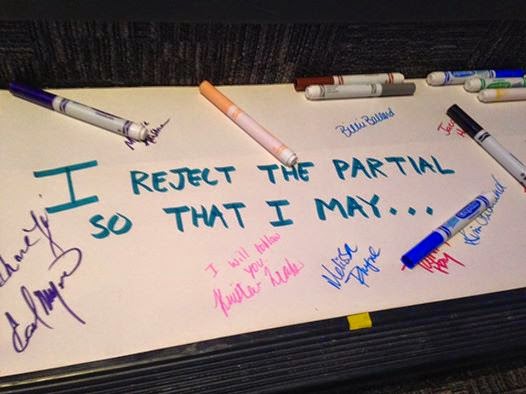
Did we get that from the Methodist hymnal? No.
Did it come from a church with a heart like Wesley’s? I pray so.


There are 7 comments
Thx for this Talbot.
Two areas I’d disagree.
First, using the hymnal liturgy or not I don’t think matters. It wouod actually be preferable to some alternatives. Blind obedience to ANY liturgical style, though, is problematic.
Second, I think it’s very Methodist to celebrate Holy Communion quarterly. It’s Wesleyan to celebrate it each Sunday. I wish you’d worked that in.
Thx for giving food for thought.
I’m with you all across the board! I’ve also had the comments that we’re “not very Methodist.” To which I answer, “We’ve very Wesleyan.” Gets a puzzled look. When time permits I tell about Wesley’s principle of ministry: The message must stay the same, but the method must change.
The truly Wesleyan altar call I know is the call to the Altar of the LORD to eat the flesh and drink the blood of Jesus Christ- the Eucharist. A truly Wesleyan “altar call” is attending to this means of grace and receiving the holy mystery. Otherwise it is really is just “what baptists do”. this altar call to holy communion is to be done as frequently as we can(John Wesley’s sermon 101, “The Duty of Constant Communion”)
As to liturgical style, I remember Father John Wesley writing, “I believe there is no Liturgy in the world, either in ancient or modern language, which breathes more of a solid, scriptural, rational piety than the Common Prayer of the Church of England.” This he wrote as a preface to his “Sunday Service of the Methodists in North America” which was an edited version of his time’s Book of Common Prayer. The book was intended to be used by the people called Methodists to shape their liturgical life- a guide for the Divine Service.
In John Wesley’s memorial, it was written that John Wesley’s goal was “to revive, enforce, and defend the pure Apostolical doctrines and PRACTICES of the Primitive Church.” If we believe so, a formal, solemn, reverent, (ritualistic if you want) liturgy as we can see in much of Anglicanism is what the Primitive Church practiced in their worship. It is therefore the “pure Apostolical practices” that the Wesleyan tradition ought to “revive, enforce, and defend.”
Just my two cents 🙂
I hate to burst your bubble but people have stood up and professed their faith and transformed their lives at the end of the “Traditional order of worship” service at my UMC. It also occurs at the non traditional worship services at my UMC. The point is not worship style but worship itself. It comes from the pastor. His teaching is biblically and Wesleyan sound. I totally agree that the upper echelons of the UMC are not very Wesleyan AND I believe that is why we have declining membership. The emphasis should be on studying scripture, personal holiness, and SAVING SOULS. Thankfully, I attend a church where we all work together and support each other to strive for those goals. We need to quit quibbling over worship styles and get to work spreading the Good News of salvation through Jesus Christ
Talbot, I think your take on what it means to be “Wesleyan” looks a lot more like early frontier American Methodism than a group or movement characterized by John Wesley’s interests, tensions and emphases. This is particularly the case when it comes to denigrating liturgy. Wesley, after all, said, “I believe there is no Liturgy in the world, either in ancient or modern language, which breathes more of a solid, scriptural, rational piety than the Common Prayer of the Church of England.”
You are right about what you claim to be “Wesleyan” distinctives–and I even agree with you about Special Sundays and Liberal Protestant “ecumenism,” but I think you do the liturgy of the church a disservice by referring to it as legalism. If anything, early American frontier Methodism had a pragmatic streak (which is what eventually created “Free” Methodists and United Methodists who dismiss the liturgy as outdated), but I don’t think there’s anything legalistic about using it, or insisting upon its use. It’s stood the test of centuries and millenia with only some modifications for a reason.
I also question the use of a worship service as an evangelistic tool, which definitely owes itself to early American frontier Methodism more than Wesley (obviously, Wesley’s situation was a bit different in that his primary ministry focus was not on a parish but on field preaching and small groups of Methodists organized into religious Societies). Quite frankly, I don’t think that rock-band worship music reaches anyone more effectively than traditional worship music from a hymnal. It may work better for a church plant or a newer church, but it definitely does not work very well with established churches…and I know I am not alone in being concerned that it creates consumers rather than worshipers.
James — you and I have often agreed on theology and sparred on style. In today’s comment you are spot on in this regard: I understand Wesleyan thought more through the lens of the American frontier experience than that of the British parish.
Honestly, I think that’s the biggest difficulty in calling oneself “Wesleyan.” ‘Wesleyan’ is a very big umbrella that goes way beyond the UMC, into the Free Methodists, the Church of the Nazarene, and on into many Pentecostal groups. Unfortunately, that big of an umbrella dilutes the precision with which the term can be used…kind of like the present-day UMC itself.
And let me add that I appreciate your consistent voice for orthodoxy. Style -can- and does matter…but substance is far, far more important.