X

Uncategorized

Uncategorized
Bring The Shout Back
June 2, 2016 at 3:58 am 0
If you Google the words “Shouting Methodist,” you’ll discover that the phrase is not an oxymoron. Instead, you’ll read these words in the first article: One name commonly applied to early nineteenth century Methodists was “shouting Methodists” – a name Methodists were glad to accept and make their own. What was meant by the term, “shouting Methodists”? At the very least, it meant that Methodists were a noisy lot, interrupting the preacher with ejaculations of “Praise the Lord,” “Hallelujah,” and “Amen.” Alexander Campbell declared that the Methodist church could not live without her cries of “Glory! Glory! Glory!” And he reported that “her periodical Amens dispossess demons, storm heaven, shut the gates of hell, and drive Satan from the camp.” Singing and clapping, groaning and crying, praying and exhorting, contributed to the din. In one Methodist hymn book, dated 1807, the initial impression of a convert is reported:
 
    The Methodists were preaching like thunder all about.     At length I went amongst them, to hear them groan and shout.     I thought they were distracted, such fools I’d never seen.     They’d stamp and clap and tremble, and wail and cry and scream.
It is clear that “shout” was a prominent part of the Methodist vocabulary. Nowhere is this more evident than in the refrains of their spiritual songs. “Shout, shout, we’re gaining ground,” they sang. “We’ll shout old Satan’s kingdom down.” The word would appear in casual conversations. An aged person, for example, would rejoice at being still able “to shout,” and a death would be recorded: “She went off shouting.”   What did it mean to “shout”? “Shouting” was never mere noise. “Shouting” was neither preaching not exhorting. Exhorting was a noisy performance, but the word had a technical meaning that was not broad enough to include even the “action sermon.” Nor was “shouting” praying, not even when praying became a din as a congregation sought to “pray down” a sinner or to contend in prayer for the souls of the penitent. “Shouting” was praise or, as it was often called, rejoicing. Both its practice, including the clapping of hands and its meaning was partly shaped by Old Testament texts (for example, Joshua 6:5-20; 1 Samuel 4:5-7; Psalm 32:11; Isaiah 42: 11-13). Initially, “shouting” was probably no more than uttering ejaculations of praise. But it quickly became, in addition to these expressions, a type of singing, a type of song, a “shout song,” or just a “shout.” If a “shout” was an expression of praise and a song of rejoicing, it also became the name of a religious service, a service of praise, a praise meeting. People spoke of going to a “preaching,” of going to a “class meeting,” and of going to a “shout”, a praise meeting. “When we get home,” they sang, “we’ll have a shout in glory.” So that’s how we got started.  But what happened?  We are now in a Methodist era in which we shout AT each other, as it seems we long ago lost the collective ability to shout TO the Lord. What if we dropped some of our liturgical legalism and started bringing the shout back, one congregation at a time?  
CONTINUE READING ...
Uncategorized
Hey World: I’m Religious, NOT Spiritual
June 1, 2016 at 3:51 am 2
Few sayings strike more fear into or evoke more apologies out of 21st Century evangelicals than the ubiquitous: I'm spiritual, not religious. We hear it from skeptical family members, from tweed-jacketed professors, from latte-slurping millennials, and we fall all over ourselves to agree, to affirm, and to identify.  In fact, on more than one occasion, when people respond to the news of what I do for a living with the spiritual not religious dictum, I have answered back with a bright-eyed, "that's great!  Same with me!" Because is not Jesus the end of religion?  Isn't religion for people who are afraid of going to hell while spirituality is for people who have been there?  Don't we want to walk by the Spirit?  When people tell us they are spiritual-not-religious, doesn't that mean we need to change our churches to fill that gap and meet that need?  Doesn't the whole S-N-R parlance suggest that our family members, professors, and millennials yearn for the liberating truth of Spirit-fueled faith rather than the shackles of man-man religion? It seems this modern phraseology and modern urges are prime territory for Acts 17, understand the culture, more U2 songs in church please!, relational evangelism. In fact, let's say it all together now, with feeling:  I'M SPIRITUAL, NOT RELIGIOUS.  Except now I know that the spiritual-not-religious line is a canard at best, a load of bull at worst.  Think of what someone -- whether connected to church or not -- is really saying when they claim that they are spiritual-not-religious:
  • I'm in this alone.  I have a connection with God/Divinity that is unique to me.
  • I will not be bound by rules that I find inconvenient or unappealing.
  • My knowledge of sacred text will be limited to:  "Don't judge me!"  (That IS in the bible, isn't it?)
  • I am unwilling to submit myself to the idea that there is a community of people who have wisdom, strength, and hope that I need to make life work. 
  • I don't have to hang around with hypocrites.
  • Newer is better and younger is smarter.
  • Best of all, I can make god into my image and thus never have to wrestle with the implications of what it means that I am made in his.
  • My highest responsibility is to be true to me.
That entire list -- as well as the premises behind it -- is antithetical to New Testament faith and to the historic Christian religion.  Yes, religion. Do you know where the word religion comes from?  From the same root word as ligament (look close, you'll see it).  And what do ligaments do?  Ligaments are connective tissue linking bone to bone.  Ligaments purposely link one part of the body with another part of the body.  Ligaments are the ultimate antidote to body isolation; they instead call out:  "You can't do this thing alone! We're in it together." And that's what religion offers that mere spirituality never can. When I say without apology that I am religious, I am saying:
  • I'm connected to a community without which I would make a mess of my life.  That community is a gift to me and gifted by me, and I am accountable to it.
  • I'm connected to history.  I didn't invent this Jesus story.  Who would ever dream something like that up?  No, I inherited his story. I am accountable not only to the story itself but to all those generations who passed it on until it landed in my lap, miraculously  so, in January of 1979.
  • I'm connected to all those hypocrites in my community and in my history.  Thank God.  Because there's always room for one more.
  • My community and my history mediate my direct connection with God.  He breaks through on occasion in moments of splendid solitude, but I hear his word best in our patterned routines of gathering, praising, lamenting, loving, and serving.
  • My highest responsibility is to be true to my calling as a follower of the One who acted decisively in history.  Being true to that calling may or may not result in personal satisfaction.
  • I recognize that my religion consists of habits and practices that are not always convenient or even interesting . . . but they are always necessary.
I suppose what it means is this:  it is only when I am sufficiently religious that I can be authentically spiritual. Would you like to receive inspiration to help build up religious small groups or Bible study groups within your church? Sign up for my Life Group Bible Studies newsletter. Are you a pastor or church leader interested in sermon help or development? Sign up for my Sermon Help Newsletter.      

CONTINUE READING ...
Uncategorized
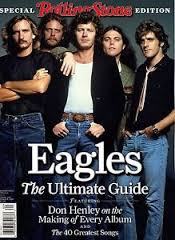
Top Five Tuesday — Top Five Observations From Rolling Stone’s “Ultimate Eagles’ Guide” Special Edition
May 31, 2016 at 3:59 am 1
With the death earlier this year of Eagles' co-founder Glenn Frey, Rolling Stone magazine just released a Special Edition, Ultimate Guide about the band.  The cover promised two pieces that I simply couldn't pass up:  1) Don Henley on the making of every album and 2) Their 40 Greatest Songs.  As you might suspect, I was eager to read the former yet raced to read the latter.   Rolling Stone Eagles So here are some things I learned from an entire Rolling Stone dedicated to my first-est, favorite-est band: 1. The late Mr. Frey's favorite Eagles' song was "One Of These Nights." 2. "New Kid In Town" may or may not have been about Bruce Springsteen.  (Whoever the subject, it still has one of my favorite lyrics ever:  "they'll never forget you til somebody new comes along.") 3. Guitarist Don Felder wrote "Victim Of Love" and thought he would be the one to sing it . . . until the rest of the band recorded Don Henley singing it behind Felder's back.  As soon as Felder heard the Henley-led song, he knew the gig was up . . . and the song was good. 4. Speaking of Don Henley, Rolling Stone describes his voice has having "sandpaper intensity."  Perfect. 5. The Top 40 is a mix of obvious selections and painful misses.  Among the obvious:  Hotel California as #1 & Take It Easy as #2.  Among the misses:  The Last Resort at #27.  Twenty-seven?  The little blurb on the song revealed that album producer Bill Szymczyk (Can I buy a vowel, please?) felt its power rivaled Hotel California itself.  Well, yeah.  So rank it up there!  Another miss:  Take To The Limit at #15, behind I Can't Tell You Why.  A final miss:  overlooked and underrated On The Border at #19, well behind the God-awful Heartache Tonight (#10).  For what it's worth -- and since it's Tuesday -- here are my Top Five Eagles Songs: 1.  Take It To The Limit.  Have you heard Randy Meisner's falsetto live?  Well, here ya go: https://www.youtube.com/watch?v=O7hmF_IX9Ic   2.  Hotel California. 3.  The Last Resort (and not just because of Producer-Guy-In-Need-Of-A-Vowel Szymczk).  If you're not familiar with here, here it is: https://www.youtube.com/watch?v=Hdx6oyBOVj0   4.  On The Border.  How can you not love a song with a "you in some trouble boy" break in? https://www.youtube.com/watch?v=wRmzajCyToo 5.  One Of These Nights  Glenn Frey was on to something.  
CONTINUE READING ...
Uncategorized
One Sunday, TWO Bottom Lines
May 30, 2016 at 3:32 am 0
Yesterday at Good Shepherd featured TWO bottom lines. What?  Did I abandon my one point sermon bonafides? Nope.  I abandoned Charlotte, NC instead.  Julie and I spent the weekend in Austin, Texas, helping my sister celebrate her 75th birthday and my mother her 100 1/2.  (When you pass 100, you get to celebrate 1/2 birthdays from then on.) So back in Charlotte, Ron Dozier delivered the sermon on Moss Road (accompanied by Sammy Gonzalez leading our Latino service) while Chris Thayer, the Zoar Campus Pastor, got to serve as the Zoar Campus preacher.  Live and in person! So Ron spoke about preventing anger and landed at this bottom line: Explore the why so you don't explode at the whoSammy had that same sentence en espanolExplorar el por qué para que no explotara en el quien. Chris preached on preventing insecurity and built his sermon on this truth: m Insecurity happens when you're at the center.  Peace occurs when God is. One Sunday, two bottom lines, a bunch of Preventology going on.  
CONTINUE READING ...
Uncategorized
You Only Get Rid Of . . .
May 26, 2016 at 4:11 am 0
You only get rid of what you refuse to get used to. I can hardly tell you how much I believe this, or how vital I think it is in both individual and organizational lives. And I believe it so much because I’ve lived it. In 2010, we who made up the leadership of Good Shepherd Church felt like we’d been plateauing for a few years. So we brought in some fresh eyes in the form of a consultant, and though we didn’t know it at the time, he turned out to be our modern-day Nehemiah! He inspected our walls and gates every bit as thoroughly as Nehemiah inspected Jerusalem. And he opened our eyes to all the things we had gotten used to, all the things that were wrong but that we no longer saw anymore. He helped us see, for instance, that we were “branding the bullet but not the gun,” meaning that we had great sermon series but the church as a whole lacked direction. He helped us see that some of our signage in the parking lot was confusing at best and unwelcoming at worst. He showed us how our exterior wall space was largely empty, and opened our eyes to ways this space could be used to fulfill our mission. For us, the exterior wall space was simply how our church building looked. The parking lot signs were just part of the scenery, and we’d been around them enough to stop seeing them as visitors did. This modern-day Nehemiah opened our eyes to the things we needed to refuse to get used to, and we were able to get rid of them. We changed our signage to be more visitor-friendly and helpful. We used our exterior wall space to display a banner that told people who we are at Good Shepherd and what we are about. And while our sermon series are still pretty good, they all serve the church’s larger mission of Inviting All People into a Living Relationship with Jesus Christ. Everything we do now supports that mission; it gives us direction and guides us toward our purpose. And it’s all because that modern-day Nehemiah helped us to see all the harmful stuff that we had settled for and learned to coexist with. You only get rid of what you refuse to get used to.   Solve   There is an important step in twelve-step recovery programs that goes like this: “We made a searching and fearless moral inventory of ourselves.” I love that. It’s really a way of saying that as part of addiction recovery, you take a merciless magnifying glass to look at your own stuff. It’s doing the work in your own life that Nehemiah did with Jerusalem’s gates and walls. It’s taking a note of every broken down wall or burned-out gate, everything that is out of place in your own heart and life, so that you can begin to make repairs. So I have to ask: What about you have you gotten used to? What is the stuff that clutters up your life, which you should never have tolerated but which you have stopped noticing?  Is it smoking? Habitual laziness? Cutting off your mind via video entertainment? Selfishness? Anger? Or maybe it’s something you have gotten used to in your relationships with others. Have you gotten used to someone’s complaining, or inattentiveness, or lack of affection? Have you gotten used to your own personal insecurity? Where in your life have you settled? What is needed for you to open your eyes and notice the clutter, so that you can stop getting used to it and start getting rid of it?   You only get rid of what you refuse to get used to.   This post is excerpted from Solve:  Finding God's Solutions In A World Of Problems, available now from Abingdon Press.  You can order it here.    
CONTINUE READING ...