X

Preaching

Preaching
Favorite Preachers
February 19, 2009 at 8:00 am 0
Here are my top five favorite preachers. Like ever.

I limit the list to those I've heard and seen in person and those whose messages have moved and shaped me as a Christian in addition to forming me as a preacher. In almost every case, these speakers have the ability to say things in a way that makes me kick myself: "why didn't I think of it that way!"

5. Howard Olds. In our first year at Asbury Seminary, Julie and I attended Trinity Hill UMC in Lexington, KY, and sat under Howard's preaching. He is still the best week-in, week-out preacher I've ever heard. He had a magnificent voice and slightly irreverent humor. Howard finished his ministy at Brentwood UMC in Nashville where he battled against cancer for the last several years. He died, too young, in the summer of 2008.

4. Tony Evans. Promise Keepers. Atlanta. 1995. He brought down the Georgia Dome -- and the 68,000 men in it -- with a clarion call to multi-racial ministry. Some of what has happened at Good Shepherd is the result of that sermon on that day. Funny, biblical, passionate.

3. Erwin McManus. Erwin McManus is the founding pastor of Mosaic Church in Los Angeles. He is also brilliant, slightly ADD, and very funny. He has designed a ministry that maximizes the arts to reach those disaffected with religion in general and Christianity in particular.

2. Chuck Swindoll. When I was pastoring in Monroe, I soaked up both his books and his radio ministry. His way of breaking down a passage and a subject influenced me for many years. And his voice . . . man, it's like God himself is speaking to you with kindness and fire all rolled together.

1. Andy Stanley. No contest. He's always speaking right to me. How does he do it? Because I'm sure he speaks directly to the 20,000 people who hear him at Atlanta's North Point Church each week as well. He gives fresh insights into familiar passages, applies those insights into life's hilarity and tragedy, and distills it all into the brilliance of the one-point sermon. All while sitting down. How'd he get so smart?

With most of these proclaimers, a Google search will also yield a YouTube link. Well worth it in each case.

CONTINUE READING ...
Preaching
Preparation & Delivery
January 9, 2009 at 7:00 am 1
I've looked at message preparation on every post this week.

By now in the process, I have selected a title, excavated Scripture, unearthed one main point, and then attempted to bring that point to life. To this point, it's all pen on paper (very 20th Century, I know).

My next step is actually to write up a manuscript (on a computer, not a typewriter!). I arrange my notes and outline, pray over the keyboard, put on a CD, and off I go. Within 90 minutes I have crafted a 30 minute sermon that will actually be delivered about a month from the time it was written.

But as most of you know, that manuscript never comes on the platform with me. Nor do any notes. That's because early each morning of the week preceding the Sunday I am to give the message, I go over it. And over it. I see what works, what needs to be changed, and what needs to be added. My memory works in such a way that I can recall the order of things by "seeing" the manuscript pages in my mind's eye while I'm giving the message.

Sometimes I forget. In the middle of a sermon. In those cases I just keep talking until it comes back to me. It usually does.

Every Saturday night, I hold my hands over the message and pray for it. I also pray for some preacher friends, that they would be windows into the very heart of God when they stand to deliver their sermon that next morning.

On recent Sundays, I have been praying that I would say things that are unplanned and not say things that had been planned . . . all according to the move of God. There are even occasions when I will hear things in the recordings of the sermons that I don't remember saying!

I have used this same basic process for all 19 years I've been giving weekly messages. The same will be true for this Sunday's talk, "Secret Pains." It's all part of the provocative series, Top Secret, which you can find more about at http://www.mytopsecret.net/.

The February series, to be called Without Limit, is threatening to upend all my conventional message preparation. I'll let you know . . .
CONTINUE READING ...
Preaching
Bringing It To Life
January 8, 2009 at 11:43 am 0

My last post talked about getting to that one thing in a passage of Scripture that is practically begging to be preached.
Once I settle on that, it's time to bring it to life.
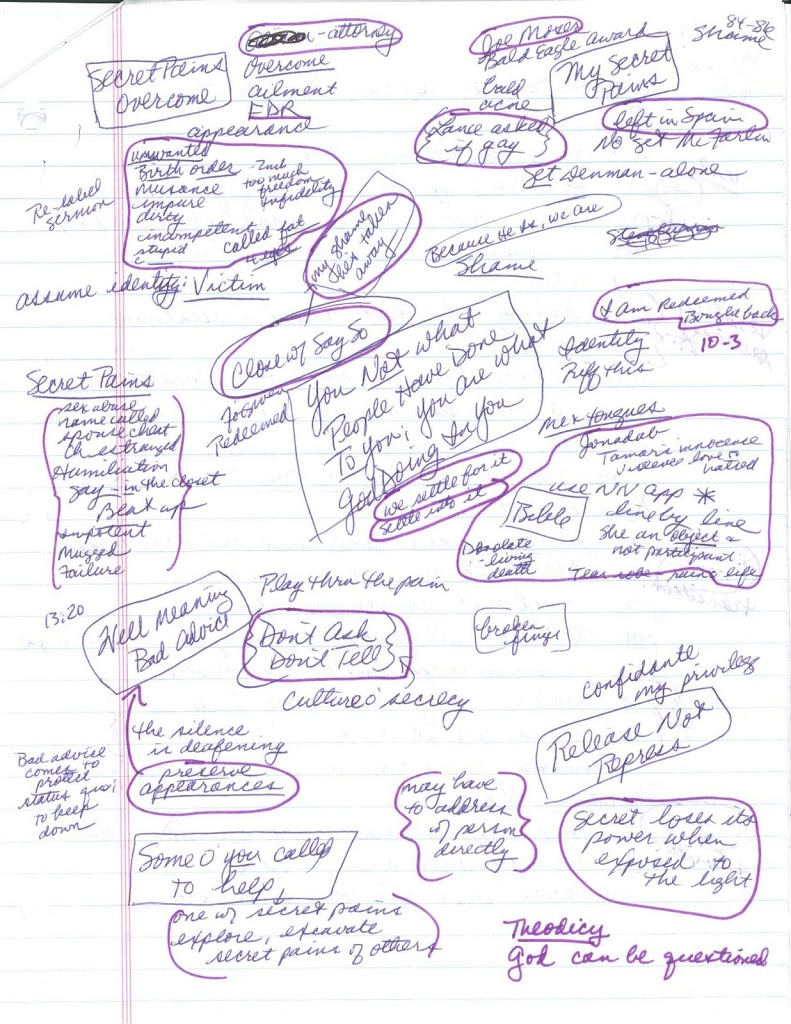
That's what happens on the sheet of paper to the right.
I get the main idea and then do a solo brainstorm around it. I jot down every memory, anecdote, insight, statistic, story, or bible verse that may have anything at all to do with the main idea. Invariably, the more ideas I have, the more ideas come. As you can see from the scribbling, there's not much I leave out!
Much less than half of what I scribble on my brainstorming sheet makes it into an outline, much less into a message itself.
But that process of thinking (literally in circles) around the big idea of the day is invaluable in giving a sermon some life. The stories that (hopefully) draw you in, the anecdotes you'll remember, the statistics that will "stick."
The scribbling in the picture was part of preparing the message for this coming Sunday -- though that scribbling actually happened over a month ago.
After I've got all the ideas, and then separated the wheat from the chaff, it's time for two more tasks in getting a message ready for delivery.
I'll let you know those tomorrow.
CONTINUE READING ...
Preaching
Getting The Sermon Out Of The Bible
January 6, 2009 at 7:00 am 0
So let's say I've got a series. I've even got a title or a starting point for a particular message.

Where do I go from there?

The bible passage itself. In general I use one passage rather than collecting several unrelated verses and making a sermon out of them. It's easier to "drill down" -- and teach well -- when you focus in on that one section of Scripture.

And somewhere in that section, there is a message for 21st Century people that is aching to come out. It's my job to excavate it.

So I read the passage. I take notes. I read it some more. I try to understand its literary structure, still using a method I was taught at Asbury Seminary back in the 1980s. See -- how a story or letter is put together is a significant part of what it is saying. So after jotting and charting and obsessing, I'll consult some other experts.

My two favorite are the NIV Application Commentary and the New Interpreter's Bible. Of the two, the "NIV App" is a bit better -- but both are good.

Then after comparing my notes with what the experts say, I try to discern the one thing in that passage that is crying out to be preached. And I try to put that one thing in a short, memorable phrase that is neither trite nor trivial. Phrases like:
  • God makes room for the ones we shut out.
  • Your secrets are the enemy of your intimacy.
  • Love your money more.
  • When you see yourself as God sees you, you'll unleash the hero within.

Then after I have that, that one thing, it's time to figure out how to communicate it.

I'll show you how that happens tomorrow.

CONTINUE READING ...
Preaching
Where Do Sermons Come From?
January 5, 2009 at 9:38 am 0
People often ask me where ideas for messages -- and even the messages themselves -- come from.

I even get asked if the Methodist Church gives its pastors the topics to address each week (the answer to that is a most definite "no.")

So where do sermons come from?

For some pastors, sermon subjects come directly from the Lectionary, which is an assigned selection of Scripture readings each week. One reading from the Old Testament, one from the New, and one from the Gospels. Pastors who use the lectionary typically then choose one of the three as the basis for a sermon. If you grew up in either the Episcopal Church or the Roman Catholic Church -- well, that's how your priests chose their sermon topics. Today, many if not most United Methodist pastors use the lectionary as well.

I tried it for my first six months of pastoring -- way back in 1990! But I quickly realized that my mind worked better in series . . . and I believe people listen better in series as well.

So these days, I keep an on-going list of possible series. I try to alternate series that are horizontal (dealing with relational issues in our daily lives) with those that are vertical (dealing primarily with our relationship with God). Top Secret, for example, is more of a horizontal series. The next series, to be called Without Limit, is, as you'll see, a decidedly vertical one.

My favorite series are those which are based on a particular book of the Bible, but see that book through an unexpected lens. For example, Oddballs was based primarily on I Peter and NUMB3RS was an entirely new way of looking at the book of Revelation.

We've already planned out the series for 2009 -- if I'm not working way ahead, I'm in trouble.

Getting back to the original question . . . where do sermons come from? Whatever the style, whatever the preparation, whether lectionary or series, my ultimate prayer is that they come from God. And that I am open enough to be used in that way.

Tomorrow, I'll touch on how with God's help I get a message out of a particular passage of Scripture.
CONTINUE READING ...