
X

Preaching

Preaching
The One Point Sermon
September 28, 2009 at 8:37 am 3
This past week, I received an email from someone who attended Good Shepherd for a season and then had to move to another part of the country. Anyway, part of his email said that he and his family still remember and use the phrase "forgiveness is learned, so teach it well." It's a phrase I used in a sermon in 2006. In fact, it was the one point from the very first one point sermon I ever delivered. And by including it in his email -- sent three years later from over 1,000 miles away -- he demonstrated the power of the one point sermon. See, for years I gave sermons that had three or four main ideas. We included a fill-in-the-blank outline. It's the way the majority of pastors prepare and deliver messages. But I've never had someone send an email three years after the fact saying "hey, Talbot, I still remember those three points that all began with the letter P!" Never. In 2006, I read Andy Stanley's Communicating For A Change and its simple logic gripped me. So I began the often arduous process of winnowing several main ideas into the one idea that must be preached -- and then crafting the best way to say it. That sermon-from-the-email back in 2006 came from the Jacob-Esau reunion story in Genesis 33, and focused on the impact it must have had on young Joseph. Previously, I would have preached that passage and gleaned a four-step process for forgiveness. That time, I narrowed it down to one: Forgiveness is learned, so teach it well. Yesterday's talk from James 2:1-9 focused on this: The favorites you play, play you. The previous Sunday from James 2:14-26: Do something for nothing. The final message in the Piece Of Work series: Your impact is greater than your memory. From Psalm 23:5-6 in the Still series: God is a people chaser. You get the idea. My prayer is that these sentences/phrases/truths will implant deeply in people's minds, thereby shaping their lives Monday through Saturday. Because you can remember and live one thing much better than four things.
CONTINUE READING ...
Preaching
I Learned How To Read In Seminary
September 23, 2009 at 6:29 am 4

With all due respect to my mother who taught me to read when I was four or five, and with apologies to my undergraduate degree in English, I really did learn how to read in seminary.

As in close reading. As in learning to observe what's going on in a piece of literature before trying to figure what it means.

In short, I learned in seminary that how a piece is written is a large part of what it is saying.

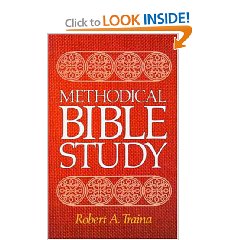
For that learned skill, I have Robert Traina's classic book Methodical Bible Study to thank.

Little known outside that sometimes insular world of Asbury Seminary, Traina's work spells out the structural elements vital to any written work: contrast, causation, cruciality, interrogation, repetition, particularization and much more.

So we learned how to read sections of Scripture by first paying attention to the structural laws at work. By looking at how the author put the words together . . . which usually opens up what that author is saying.

Twenty-two years after my first exposure to Methodical Bible Study, I'm still using its principles when I study passages to prepare my messages. It has been especially helpful in picking apart the book of James for the Rubber, Meet Road series.

So check out Methodical Bible Study. Perhaps you can learn how to read without ever going to seminary.
CONTINUE READING ...
Preaching
What Country Music Teaches Me About Preaching
September 10, 2009 at 5:26 am 5
Have you ever noticed that you can see a good country music song while you are hearing it?

I'm only an occasional fan of that genre, but I continue to be impressed by the word pictures most country songs make. Whether it is Carrie Underwood's vivid description of ruining her boyfriend's car in Before He Cheats or the masterful turns of phrase in Kenny Chesney's There Goes My Life, country songs are the most visual of any popular music.

Perhaps the most representative is Brooks & Dunn's Red Dirt Road:

"Red Dirt Road"

I was raised off of old Route 3
Out past where the blacktop ends
We'd walked to church on Sunday morning
Race barefoot back to the Johnson's fence
That's where I first saw Mary
On that roadside pickin' blackberries
That summer I turned a corner in my soul
Down that red dirt road

It's where I drank my first beer
It's where I found Jesus
Where I wrecked my first car
I tore it all to pieces
I learned the path to heaven is full of sinners and believers
Learned that happiness on earth ain't just for high achievers
I've learned I've come to know
There's life at both ends
Of that red dirt road

Her daddy didn't like me much
With my shackled up GTO
I'd sneak out in the middle of the night
Throw rocks at her bedroom window
We'd turn out the headlights
Drive by the moonlight
Talk about what the future might hold
Down a red dirt road

I went out into the world, and I came back in
I lost Mary, oh I got her back again
And driving home tonight feels like I've found a long lost friend

Notice all the nouns? The red dirt road itself, the church, the blackberries, the young girl Mary, the beer, the Pontiac GTO. You don't just hear the song; you see it as well.

So what does that have to do with preaching? Everything.

A good sermon, I believe, is not something people merely hear. They see it. A good sermon is full of concrete language, vivid descriptions, and word pictures that involve multiple senses. Such messages engage people's minds and involve practical, daily application.

So preachers: prepare and deliver sermons the people in the church can see.

And worshippers: watch for the message your pastor delivers this Sunday.

Just like country music.
CONTINUE READING ...
Preaching
Subtle Influences?
June 16, 2009 at 6:19 am 1
Yesterday's post ended with a question: what seen and unseen influences might have led me to sense that God was moving me towards pastoral ministry?


I've thought about that question for the last several days.


As far as I know, there were not any pastors on either side of my family tree. My mother's family had both Quaker and Episcopalian influences; my father's side had some Christian Science. So there was certainly never any expectation or pressure that one of us Davises would grow up and enter into ministry.

So I believe the influences were more subtle.

For one, my mother taught me to read at a very young age. I was always oriented towards words and how to put them together. That sort of helps in preaching.

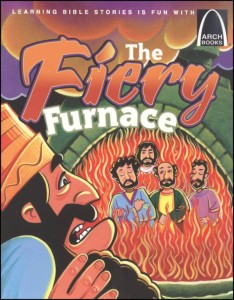
And some of my earliest reading memories center on the Arch Bible Story series. Like this one about Shadrach, Meshach, and Abednego:


Those books are how I first found out about the parable of the talents, Jonah and the fish, and David & Goliath. In fact, I can still hear my mom's voice reading "And Goliath was dead." In the picture book, the stone hit him in the middle of the forehead; we agreed (mom and 5-year-old me) that it more likely hit him in the temple.

I guess you could say that I saw the bible before I ever read the bible.

A second subtle influence was my dad's job on the law faculty of Southern Methodist University. We weren't Methodist and I never attended a Methodist church until I was 20, but as a kid my world revolved around that university. Walking its campus, hearing its stories, and living & dying (usually dying) by the results of its sports teams. I figure that somewhere, deep in the recesses of my mind, there grew a positive association with what it means to be Methodist.

There have been other influences that drew me to ministry. Most of them not so subtle. Yet the experiences and memories of early childhood shape us in ways beyond our understanding.

In other words, against all expectation, they help land me in the pastoral ministry of the United Methodist Church.
CONTINUE READING ...
Preaching
Reflections On Reflections On My Call To Preach
June 15, 2009 at 11:59 am 1

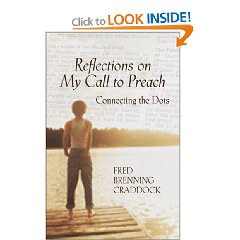
While in Lake Junaluska last week, I picked up and read a delightful little book by Fred Craddock called Reflections On My Call To Preach.

Craddock is professor emeritus of preaching at the Candler School of Theology, the United Methodist Seminary at Emory University. (Yes, a competitor of the great Asbury, but I'll let it pass.)

Craddock was one of the first narrative preachers I ever heard -- he could weave stories together in his sermons in a way that left the hearer spellbound. And he had an uncanny knack of connecting it all together at the end so that you, the listener, could reach the conclusion for yourself.

He's one of those preachers about whom other preachers always say, "I wish I could do it like that."

But this small memoir covers the influences on Craddock's life from birth through his departure for college at the age of 18. Each influence -- whether his family tree, his parents, his school experience, or even the crushing poverty of western Tennessee in the Depression -- had a role to play in his growing sense that God was calling him to become a pastor. For any of the generations of Methodist pastors who have been influenced by Craddock's preaching, it is a quick, easy read that lets you know how he became who he became.

And it all got me wondering . . . what kind of seen and unseen influences moved me to sense that God was calling me to this kind of work? Another time, perhaps, and another post.
CONTINUE READING ...