X

Pastoring; Leadership

Pastoring; Leadership
Preaching To Preachers
January 4, 2012 at 6:00 am 1
We have a number of pastors who attend Good Shepherd.

Some of them are missionaries who have returned from overseas and are in the midst of discerning their next steps in ministry.

Others are pastors-in-training, studying either at bible college or seminary and in search of a spiritual home while preparing for a lifetime of service.

Still others have left vocational ministry and now work in the marketplace.

And a few are in between ministry assignments, praying to discern where God would send them next.

They bring with them stories of how they have seen God move in dramatic ways.

They also bring battle scars from the times God's people behaved in ungodly ways.

They also bring a variety of assumptions about how pastoral ministry should be carried out.

Most remarkably, they bring a desire to serve the Body of Christ in this particular context . . . a setting where they will receive few accolades as "pastor," "leader," or even "servant."

What they may not know they bring to me personally is an enormous resevoir of grace. Because preaching to fellow members of the preaching guild is a uniquely stomach churning experience.

"Has he used that same illustration before?"

"Is he going to notice that I used some liberty in interpreting that passage?"

"Will she think I'm sacrificing depth for breadth?"

"Can I possibly speak something fresh into his life when he's been through so much?"


Yet in spite of my nerves, this group of pastors-as-congregants is unflinching in their support and their encouragement.

I suppose that's because they know better than most what my shoes feel like.

CONTINUE READING ...
Pastoring; Leadership
Progress, Counseling, and Church Unique
November 16, 2011 at 8:24 am 2
I recently heard a pastor I respect very much say that church leaders who place a high value on progress are typically very poor at pastoral counseling.

What he was saying made intuitive sense: people who have a bias for progress by definition look to the future. They enjoy dreaming, provoking, cajoling, and implementing. They advance the mission of the ministry forward.

In contrast, much of counseling -- by definition -- looks to the past. It explores factors in childhood and adolescence that land people at their particular point of need. Counseling is usually a slow process with improvement coming in barely measurable increments -- if at all.

So, according to the message I heard, pastors who are wired for progress find the role of pastoral counselor inherently frustrating. The advice was pretty clear: if you want the church to advance, don't spend time in counseling sessions.

Yet hearing the CD that day brought with it a huge "Uh-oh" moment for me.

Why? Well, I want the church to progress. I don't want it to stay the same . . . and it hasn't, either in style or in number or in impact. I'd like the progress to be more dramatic, perhaps, but I still long for it.

Yet I also believe pastoral counseling is a critically important piece of what I do as a minister. I make myself available for it. If I can't do it, I ensure others can. And sometimes, I can even tell that God transcends my limitations and good results have come from pastoral counseling I've done.

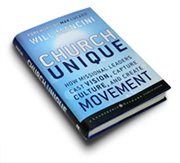
So as I was wrestling with the dilemma, the name of the book we've used to help us land at Inviting All People Into A Living Relationship came to mind: Church Unique. Not Church Identical. Not Church Copycat. Not even Church Northpoint. Church Unique.


In other words, simply because I pastor whom I highly respect can't be involved in counseling due to his bias for progress, that doesn't mean I have to make the same decision.

His style works well in his setting. God is doing a unique thing there.

But he is also about a unique thing here.

So perhaps we can create a culture at Good Shepherd in which the congregation's future takes shape at the same time that personal histories gets healed.

I'd call that progress.
CONTINUE READING ...
Pastoring; Leadership
Blessing Houses
November 18, 2010 at 6:00 am 2
My cyber friend John Meunier has a interesting post on house to house visitation on the part of pastors.

The timing was ideal.

Just last evening, I went "blessing houses" with another preacher friend -- this one from Huntersville and he's a man I've met him in person rather than just through theological cyberspace.

I was sharing Good Shepherd's approach of "high touch, low threat" evangelism. We greet new movers to the area with a smile, a card, and a "World Famous Refrigerator Magnet."

Approximately 200 people who had their first contact with Good Shepherd through Bless This House now call this church home.

So we're hoping the Huntersville church can have the same kind of impact.

House to house? All for it.
CONTINUE READING ...
Pastoring; Leadership
The Freedom Of Preparation
April 27, 2010 at 6:47 am 2
A friend told me recently, "There is so much freedom in preparation."

That sounds counter-intuitive, doesn't it? We think of preparation as . . . drudgery. Monotony. Repetition. Whether it's preparing a sermon, report, or song, the work of getting ready is filled with discipline and sacrifice. All of which sounds like the opposite of freedom.

Except for this truth: a lack of preparation makes you a captive of the moment. There are few things more paralyzing than to be giving remarks for which you are unprepared -- you know it and the people you address know it as well. You're trapped.

I suspect the same is true in singing a song, writing a report, or making a sales presentation.

And the reverse is equally apt. Spontaneity happens best in the middle of a message that has been carefully crafted. It's as if when you do your part, the Spirit pours out surprises by doing his part. Many Sundays, some of the "best" things I say are not part of the plan . . . yet delivered while in the middle of sticking to the plan!

So in preaching, singing, selling, writing: there is freedom in preparation.
CONTINUE READING ...
Pastoring; Leadership
What I Miss About A Small Church
January 13, 2010 at 7:43 am 2
From 1990-1999, I served in what Methodists call a "two-point charge": Mt. Carmel & Midway United Methodist Churches in Union County.

At 9:45, I would preach at Midway, an open country church that averaged about 30 people per Sunday when I arrived. By the time I left nine years later, I had grown that 30 to 20.

Then I'd drive 13 miles to Mt. Carmel Church, arriving just in time to preach at the 11:00 a.m. service. Mt. Carmel was much the larger congregation, averaging about 70 people per Sunday when we got there. It was blessed with excellent growth over the next nine years. Our house -- the church parsonage -- was adjacent to Mt. Carmel. So each Sunday was a 26 mile round trip.

Obviously, those churches are much different than the situation at Good Shepherd. I still have to pinch myself sometimes as I marvel at the level of favor God has poured into us here.

Yet I have to admit, there are some things about that season of life and that style of ministry that I miss . . .

1) In a small church there is time to hear people's stories. Through those nine years, I had hundreds of pastoral visits that were unrelated to crises -- there was plenty of time to sit, listen, and pray. One of the trade-offs of a larger church is that I get to know people primarily through crises.

2) In a small church, I felt more dependent on God's power. If anything good would happen at those two churches, God would have to do it. Some of my strongest prayer times ever happened in the little prayer room we established at Mt. Carmel.

3) My schedule was blissfully simple: work on sermons in the morning and visit in the afternoon.

4) Whenever we accomplished something significant -- for example, Mt. Carmel built a Habitat house all by itself in 1994, a remarkable achievement for a church that averaged 115 people in worship at that time -- there was time to rest and reflect. When good things happen at Good Shepherd these days, I'm immediately filled with anticipation: "Ok, how are we going to top this?"

I'm quite convinced that the small church experience has made me a better large church pastor. And I don't want to return to that kind of setting or ministry.

But I do want to keep learning its lessons . . .
CONTINUE READING ...