X

Good Shepherd; Missions; India

Good Shepherd; Missions; India
You Would Have Been Proud . . .
March 15, 2012 at 10:18 am 2
. . . of your Good Shepherd team in India today.

James-Michael Smith and Chris Thayer had their opening teaching sessions today.

After I gave the opening talk in which I spoke about Sunday sermons not as disconnected pieces but as parts of an integrated whole -- in other words, it's better to preach in series rather random messages week by week -- we settled down into the meat of the day. James-Michael on the Old Testament and Chris on the intertestamental period between the Old and the New.

Here are some of the nuggets I got from their talks:

In the Old Testament, God is active outside of Abraham, but the focus within the bible is how God uses Abraham and his family to rescue the world.

Abram means "exalted father." The name change to Abraham means "father of many."

Early on this was Abraham's crisis: how could he be the father of many when he wasn't the father of any?

God says to Abraham, "I will keep my promise to you at the cost of my life."

When Jacob wrestles with the angel in Genesis 32, God changes his name to Israel which literally means "one who struggles with God."

As a nation (the ancient people, not the modern state), Israel is how God will reach the world.

The old covenant was written on stone tablets; the new is written in human hearts.

Jesus was a descendant of Abraham who kept the Old Covenant perfectly and brought it to a close so the New Covenant can now reach the nations.

Jacob (Israel) had 12 sons. Jesus had 12 disciples.

Israel came out of Egypt as an infant nation. Jesus came out of Egypt as an infant.

Israel crossed the Jordan on the way to the promised land. Jesus crossed the Jordan in his baptism.

Israel wandered in the desert for 40 years. Jesus was tempted in the desert for 40 days.

Jesus takes on the identity of Israel and walks it out . . . if you know the story of Israel you know the story of Jesus.

There are three parts to the context of Scripture: 1) Behind the text which is the the history of authorship and audience; 2) Inside the text which involves the purpose of the writer and the kind of literature involved; 3) In front of the text which is what WE bring into the reading of it.

In between the testaments, God was supposed to bring a king to Israel but instead Roman kings like Pompeii walked into the temple and made fun of God.

The people longed for a king who would deliver them from their oppressors.

When he first performed miracles, villagers expected Jesus to be their military king. That's why he often told them to keep his miracles quiet . . . it was his way of telling them, "I'm not THAT kind of king and this won't be that kind of kingdom."


After that rich teaching, we sat down with some of the pastors who speak English.

The most poignant moment came in response to the question, "have you ever been persecuted for your faith here?"

"My father was killed and I was beaten," one man answered softly.

"Did it ever make you want to give up since it would obviously be easier on you not to follow Jesus?" I asked.

"Of course not," he said. "I will keep preaching to the end."

And we're trying to teach them?

CONTINUE READING ...
Good Shepherd; Missions; India
How India Wakes Up
March 14, 2012 at 8:37 pm 0
One of our hosts here in the city of Balasore -- a man who has spent some time in the United States -- explained to me the difference between waking up in the US and waking up in India.

"In America, you wake up to silence," he said. "In India, we wake up to noise."

As I woke up today (Thursday morning in India), I understood what he was talking about.

See, if you live in a typical subdivision in Steele Creek, Lake Wylie, or Fort Mill, whatever noise surrounds your morning ritual probably comes from inside your house: babies crying, children talking, coffee pouring, or TV talking heads pontificating.

Outside your house is a different story. With the exception of an occasional school bus or speeding car, the wee hours of the morning are as quiet as they are dark.

Not so here. When you wake up in India -- or, more accurately, when you get woken up in India -- it is to a cacophony of people, vehicles, and horns. Mostly horns.

Remember the vuvuzela horns from the World Cup Soccer matches in South Africa a couple of years ago? That's what we have here. At 4 a.m. And 4:01 a.m. And 4:02 a.m. And on and on.

The sounds of life, struggle, survival, and ambition on the Indian streets every morning.

Most definitely not the sounds of silence.
CONTINUE READING ...
Good Shepherd; Missions; India
When A State Changes Its Name
March 13, 2012 at 7:02 pm 0
I told you on Monday that our ministry time in India focuses on the northeastern state of Orissa.

And then our plane landed here later that day and I found out the name of the state had been changed in recent months.

What was Orissa is now Odisha.

The two words sound similar -- whether coming out of mouths that speak English or the local language of Oriya -- yet the name change is highly significant.

In recent years, the political leadership of India has tried to remove most remnants of British influence over the land. (As many of you know, India was a British colony for the 200 years prior to 1947.)

That's why the city of Bombay no longer exists. Today it's Mumbai.

Yesterday's Calcutta is today's Kolkata. The former Madras is now Chennai.

So the name Odisha is more indigenous than the Anglicized Orissa.

What does that mean for ministry in the 21st century? Not a lot, perhaps.

Or perhaps a great deal. As India's prosperity and influence grow, so does its national pride. Deservedly so. And with many people here, that development also involves a suspicion of all things Western, Anglo, and American. Not hostility as we might find in some countries. Instead, a guarded suspicion.

So our team does all it can to honor what is indigenous in Indian Christianity. All too often, believers from the US have wanted developing peoples to become "American" as part of becoming "Christian." Well, Acts 15 settled that long ago. Christ calls people to himself first and to a culture second.

So we'll honor that which is from Odisha -- no longer Orissa -- while sharing what we worship in Christ with our new friends.

----------------------------------------------------------------

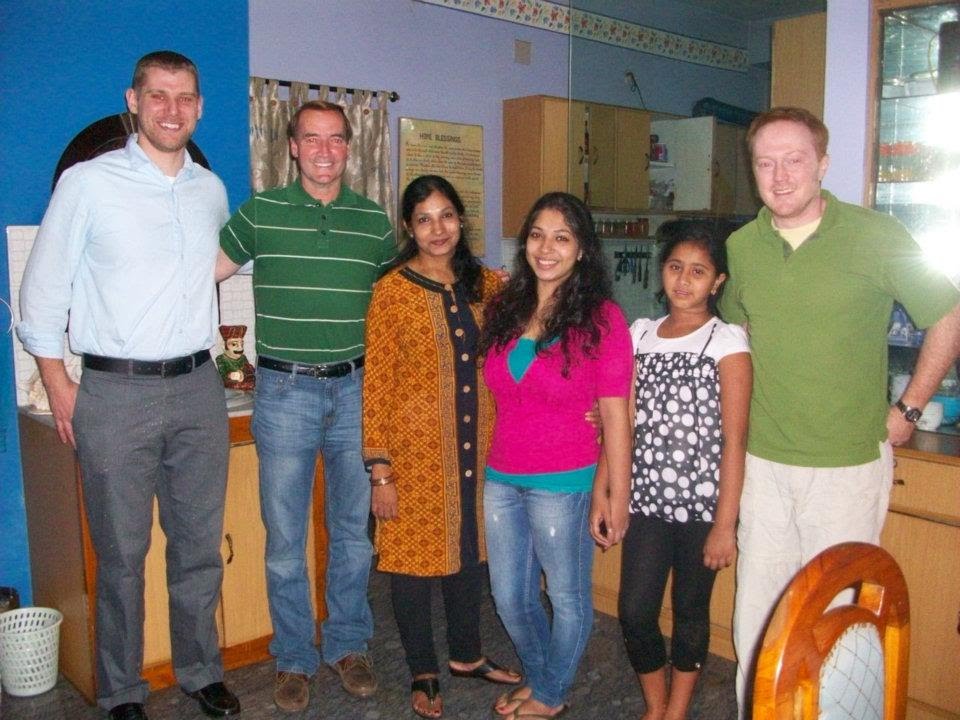
Here's a dinner shot with our hosts, PR and Anju Misra and their family:


Later on Wednesday, we drive to the town of Balasore, Odisha, to begin training and encouragement with local pastors there.
CONTINUE READING ...