X

Communication

Communication
Conversation & Posture
December 30, 2010 at 7:32 am 1
A couple of people have let me know in a loving way that I sometimes talk to people while backing up, walking away from them.

That's really bad.

It conveys all the wrong messages: I'm too busy, I'm doing something else, I'd rather be somewhere else, I don't have time.

Yuck.

So I've been thinking about the balls of my feet . . . as in leaning forward on my feet while engaged in conversation. It's awfully hard to back up and lean forward at the same time.

Maybe then I'll convey some right messages: I've got time, This matters, I'm glad to be right here.
CONTINUE READING ...
Communication
Credible Communication
October 8, 2008 at 1:37 pm 0
Quick: which of these animals is more likely to kill you?

A SHARK A DEER

Answer: The deer is more likely to kill you. Actually, it's 300 times more likely to kill you via a collision with your car than a shark is through, uh, consumption in the ocean.

That's a true statistic from the Florida Museum of Natural History as found in Made To Stick, the masterful communication book by Chip and Dan Heath. The Heaths call that kind of communication credible, meaning that it has the kind of unexpected truth about it that once you give it some thought you say, "of course."

Credibility goes beyond hard numbers and into the realm of lived experience: "see for yourself if this is true or not."

It's why I can't preach on tithing if I'm not tithing myself. It's why the staff can't teach on serving if it is not serving itself. It's why the church can't talk about compassion without being compassionate itself.

I guess it's why we're having so much fun hosting our twelve new friends from the Salvation Army this week. I pray it makes all the talk here credible.
CONTINUE READING ...
Communication
Made To Stick
September 22, 2008 at 7:09 am 0
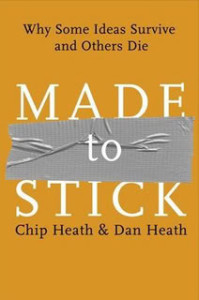
I am a great fan of Chip and Dan Heath's Made To Stick:
Photobucket

The book's focus is corporate communication -- advertising and product development primarily -- but it more than applicable to the church world. In fact, I would make it required reading if I were teaching a class in preaching and/or worship.

So over the next couple of weeks, I want to highlight some of the book's teachings and how it has impacted what we do at Good Shepherd.

The Heaths contend that effective communication is . . . .

Simple
Unexpected
Concrete
Credible
Emotional
Story-Driven

That spells "Success" if you throw in an extra "s" at the end.

Simple. This one is perhaps my favorite. Made To Stick teaches that if you communicate three things in a given presentation, you have in effect communicated nothing. So we try to communicate one thing each Sunday. Yesterday, for example, it was your flaws are just your strengths in disguise, a truth drawn from the story of Jacob in Genesis 32:22-32. Everything we did, from music to video to message, was designed to hammer that one idea home.

I know that this simplicity works because of the number of times people repeat back to me the one point from a given service. Often several months later. Because we don't overload people with information, what we do communicate has a freshness and an urgency about it.

Later this week, I'll post on unexpected communication. But if I told you which day that post was coming, it wouldn't be unexpected would it?


CONTINUE READING ...
Communication, Good Shepherd, Leadership
Breaking Communication Breakdowns
May 28, 2008 at 9:53 am 0
I love Chip and Dan Heath's Made To Stick. That's why it's on my favorites list on this blog. Written from a corporate perspective, it's all about communication.

If you are passionate about communicating important stuff, and doing it in a way that reaches people in the 21st Century, you'll want to check it out.

Made To Stick showed me that communication needs to be simple, unexpected, concrete, credible, emotional, and story-driven.

That's why so many things have changed in our communication style around here:


  • Moving from sermons with multiple "points" and "illustrations" to sermons with one main "point" supported by visual "animations."
  • Greater use of video imagery to tell stories and support songs.
  • A church bulletin heavy on visuals and light on "church news."
  • A growing commitment to "less is more." We try to avoid information overload (something into which churches easily fall) and instead highlight those things that speak to the largest number of people.

So my prayer is that what we say is "sticking" in the minds and hearts of the people of Good Shepherd.

CONTINUE READING ...