Heath Bradley is a teaching pastor and emerging scholar based out of the
Pulaski Heights UMC in Little Rock, Arkansas.
We have become cyber-friends and he invited me to use this blog to review his new book,
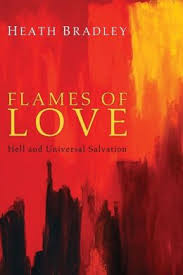
Flames Of Love: Hell & Universal Salvation.So, here goes.
------------------------------------------------------------------------------------------------------------------Much like John the Evangelist who gives the purpose statement of his Gospel near the
end (John 20:31), so Heath Bradley provides the most compelling motivation for his book
Flames Of Love on page 131:
[I am advocating] a very particular Christian version of universalism where the uniqueness of Christ and the reality of postmortem judgment are integral and foundational aspects.
So: Bradley sets out to prove that at the end of the end all souls (and by implication, their resurrected bodies) will be delivered into God's presence. BUT that salvation will only happen because of Christ (in other words, judgment is not based on Islam's scales or Buddhism's wheel but strictly through Jesus' cross) and only after a time of hell-ish punishment following death for those who have not surrendered to Christ during their time on earth. In Bradley's view, "hell [is] temporary in duration and . . . corrective in function (p. 49)."
How does he do with his assignment?
I would say remarkably well. Bradley is able to maintain a vigorous commitment to historic orthodoxy while also defending his claim that all will be saved in the end. There is not a hint of the Unitarian, "all religions are just different paths to the same goal," in his argument. His words and logic carry much more intellectual force than the feel-good universalism of those on the edges of Christianity.
Bradley is at his most compelling when he notes:
1. The Meaning Of "All" And "Eternal"
Traditionalists [those who believe in everlasting punishment] have to try to explain why "all" doesn't really mean all when it comes to who will be saved, and the universalists have to explain why "eternal" doesn't really mean eternal when it comes to the duration of the punishment in the age to come (p. 58).
As example of the former, check I Corinthians 15:22: For as all die in Adam, so all will be made alive in Christ.
And Romans 5:18: Consequently, just as one trespass resulted in condemnation for all people, so also one righteous act resulted in justification and life for all people.
Conversely, as an example of the latter, read Matthew 25:46: Then they will go away to eternal punishment, but the righteous to eternal life.”
And Jude 1:7: In a similar way, Sodom and Gomorrah and the surrounding towns gave themselves up to sexual immorality and perversion. They serve as an example of those who suffer the punishment of eternal fire.
2. The Way Jesus Himself Preached About Hell
"You see, when we make hell just about what happens to outsiders in the next life, we miss the fact that Jesus made his warnings about hell primarily in relation to what insiders do in this life (p. 40)."
Gulp!
3. The Strain of Christ-Centered Universalism in the early church
Bradley goes to great lengths to place his views as another in a long line of orthodox thinkers. In particular, he notes the Gregory of Nyssa, who was most influential in developing the Nicene Creed, "strongly affirmed the restorative and temporary nature of God's punishments and the eventual salvation of all people (p. 9)."
4. The Overwhelming Nature Of God's Love
"God's love for us will be more relentless than our rejection of him (p. 101)." (Romans 8:38-39)
5. What God REALLY Wants To Punish
"God's goal is not to damn sinners, but to destroy sin and the way God destroys sin is by drawing sinners close to his heart of holy love which burns like a refiner's fire (p. 51)."
And where does Bradley's argument fall short?
1. His Take On The Closing Section Of Revelation
Bradley argues convincingly that the gates of heaven in Revelation 21:5 are always open -- suggesting that even after "the end" people will be returning to their Father. Yet he overlooks the peril described just a few verses earlier in 20:11-15:
Then I saw a great white throne and him who was seated on it. The earth and the heavens fled from his presence, and there was no place for them. 12 And I saw the dead, great and small, standing before the throne, and books were opened. Another book was opened, which is the book of life. The dead were judged according to what they had done as recorded in the books. 13 The sea gave up the dead that were in it, and death and Hades gave up the dead that were in them, and each person was judged according to what they had done. 14 Then death and Hades were thrown into the lake of fire. The lake of fire is the second death. 15 Anyone whose name was not found written in the book of life was thrown into the lake of fire.
While most scholars read that "fire" as more evocative than literal, nevertheless the destruction described appears irrevocable.
While we're in the apocalyptic section of the biblical library (or, as Bradley calls it, the "anthology"), note the finality of Daniel 12:2: Multitudes who sleep in the dust of the earth will awake: some to everlasting life, others to shame and everlasting contempt.
2. His Selectivity In Choosing Church Fathers
Bradley relies on Gregory of Nyssa in much the same Rob Bell leans on Origen to advance a similar argument in Love Wins. What both Bradley and Bell miss, however, is that in appealing to tradition one should point to the best collected wisdom of the church. And the consensus of the early (and medieval and Reformation) church was that eternal punishment is in fact eternal.
What About Style Points?
1. Bradley Brings Levity To His Chapter Titles
For example: Get The Hell Out Of Here?; A Hell Of A Choice; A Hell Of A Lot To Think About. Trade secret: most preachers relish the opportunity to get away with just a little bit of profanity now and then.
2. His Writing Style Turns A Heavy Subject Into Easy Reading
Bradley's favorite word is "coherent" (as well as its verbal form, cohere, and its negative form, incoherent) -- see the Preface as well as pages 35, 41, 53, 58, . . . . -- and I found that his writing contributed to the overall coherence of the book. With one exception (see below).
3. Is It An Academic Book Or A Popular One?
For the most part, Flames Of Love seems ready to be studied in seminaries and quoted in journals. Yet Bradley has an unfortunate tendency to slip into colloquialisms: "a church culture that has held some pretty stupid and very dangerous views" (p. 34); "I would be a huge hypocrite" (p. 46); "I know this doesn't sound very nice to say, but" (p. 51); "hell is not some small thing that really isn't that big of a deal" (p. 136). I found myself longing for Bradley to settle on one style and stay there.
And In The End . . . .?
Heath Bradley has done the church in general and his cause of Christian universalism in particular a great favor with the publication of Flames Of Love.
His engagement with the texts of the Scriptural anthology, his familiarity with the voices of antiquity, and most of all, his unwavering commitment to the uniqueness Christ, all add weight to his central premise: hell exists more for eternal purification than for eternal punishment.
In fact, I'd love to get to heaven and discover that he is right.From the viewpoint of earth, however, I don't believe he is. The repeated finality of the majority of biblical passages plus the collective wisdom of those closest in time to Jesus lead me to the conclusion that whether it's salvation or separation, eternal in fact means forever.