


Not too long ago, in the midst of some channel surfing, I came across a bit of a sermon by Rod Parsley.
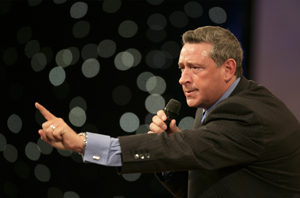
And after a particularly emphatic point — come to think of it, he makes no other kind — Parsley said, “you all should be running in the aisles after that one.”
Meaning . . . if the people of the congregation agreed with the words just spoken, they should signify their assent to the word AND their praise to God by running up and down the aisles of the church.
Which got me to thinking . . . are people in that particular church more because of theology or psychology?
Do they attend Parsley’s church because they received a kind of theological revelation that convinced them running (or falling or dancing) is the purest form of worship?
Or does Parsley’s church attract people who are already wired (by a combination of genetic makeup and environmental influences) to respond to outside stimuli with personal emotion and bodily motion?
Which is it?
For example, while Good Shepherd is known for having worship that is expressive and exuberant, I can’t imagine in a million years imploring people to run in worship. Is that because I think running is wrong or because I am more reserved than Rod Parsley?
Do our Episcopalian friends observe worship patterns that are both reverent and ancient because they believe it’s more true to God’s will . . . or does the Epsicopalian church instead draw people who are already wired to believe God lifts his pinky finger just so when having afternoon tea?
What’s the source of these worship differences that some of us have seen descend into worship wars: the nature of God or the nature of us? Theology or psychology?
A question I raise; an answer I seek.



There is 1 comment
I don’t think I have ever watched a Rod Parsley sermon all the way through but I will sometimes linger for awhile to watch and listen as I channel surf.
I would imagine it is a bell curve kind of thing, with a small number on one end being driven in their church worship practices by theology and at the other end by their psychology or upbringing or whatever. The vast majority are in the middle being nudged one way or the other by the community of which they are have chosen to be a part. You could probably throw in some socioeconomic motivations too.
I remember being shocked at the first Charismatic Baptist church I came across. I would also be shocked if a Presbyterian church of any flavor would include snake handling in their services.
It is on pastoral and worship leadership to be challenging congregants to respond to truth and God’s presence by doing something in a new way, though certainly not for the sake of newness or to follow a fad. It is on the congregants to feel the freedom to do what the Spirit is prompting them to do without first thinking of what people will think. The bigger danger is in not going far enough than in going too far.
That said, if we won’t have folks running in the aisles can we at least get the occasional worshipper slain in the Spirit?