



I recently heard a pastor I respect very much say that church leaders who place a high value on progress are typically very poor at pastoral counseling.
What he was saying made intuitive sense: people who have a bias for progress by definition look to the future. They enjoy dreaming, provoking, cajoling, and implementing. They advance the mission of the ministry forward.
In contrast, much of counseling — by definition — looks to the past. It explores factors in childhood and adolescence that land people at their particular point of need. Counseling is usually a slow process with improvement coming in barely measurable increments — if at all.
So, according to the message I heard, pastors who are wired for progress find the role of pastoral counselor inherently frustrating. The advice was pretty clear: if you want the church to advance, don’t spend time in counseling sessions.
Yet hearing the CD that day brought with it a huge “Uh-oh” moment for me.
Why? Well, I want the church to progress. I don’t want it to stay the same . . . and it hasn’t, either in style or in number or in impact. I’d like the progress to be more dramatic, perhaps, but I still long for it.
Yet I also believe pastoral counseling is a critically important piece of what I do as a minister. I make myself available for it. If I can’t do it, I ensure others can. And sometimes, I can even tell that God transcends my limitations and good results have come from pastoral counseling I’ve done.
So as I was wrestling with the dilemma, the name of the book we’ve used to help us land at Inviting All People Into A Living Relationship came to mind: Church Unique. Not Church Identical. Not Church Copycat. Not even Church Northpoint. Church Unique.
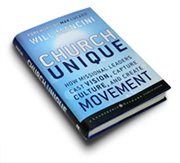
In other words, simply because I pastor whom I highly respect can’t be involved in counseling due to his bias for progress, that doesn’t mean I have to make the same decision.
His style works well in his setting. God is doing a unique thing there.
But he is also about a unique thing here.
So perhaps we can create a culture at Good Shepherd in which the congregation’s future takes shape at the same time that personal histories gets healed.
I’d call that progress.






There are 2 comments
Should my pastor make himself unavailable to meet with me, pray with me or guide me (counseling), I’d be looking for a new place to worship.
Counseling Pastor:
“If you keep carryn’ that anger, it’ll eat you up inside, baby
I’ve been trying to get down
To the heart of the matter
But my will gets week
And my thoughts seem to scatter
But I think it’s about forgiveness
Forgivness
Even if, even if you don’t love me.”
Non-Counseling Pastor:
“And you were just too busy being fabulous
Too busy to think about us
I don’t know what you were dreaming of
Somehow you forgot about love
And you were just too busy being fabulous.”
Thank you Talbot for taking time out of your day to pray with me and guide me (counsel me).
Not too many people can do a “Too Busy Being Fabulous” reference on a pastor blog post! That’s worthy of a shout out.